Is a Shikoku the Ultimate Hiking Dog? An Honest Assessment
When I first started looking for a dog, I wasn't thinking about hiking. I wasn't thinking about trail compatibility or endurance or prey drive management. I just wanted a dog that felt right — something compact, sturdy, and a little different. I'd grown up with German Shepherds, so I knew I wanted a breed with some substance to it, but I was drawn to something more independent, more primitive. That search is what led me to the Shikoku Ken.
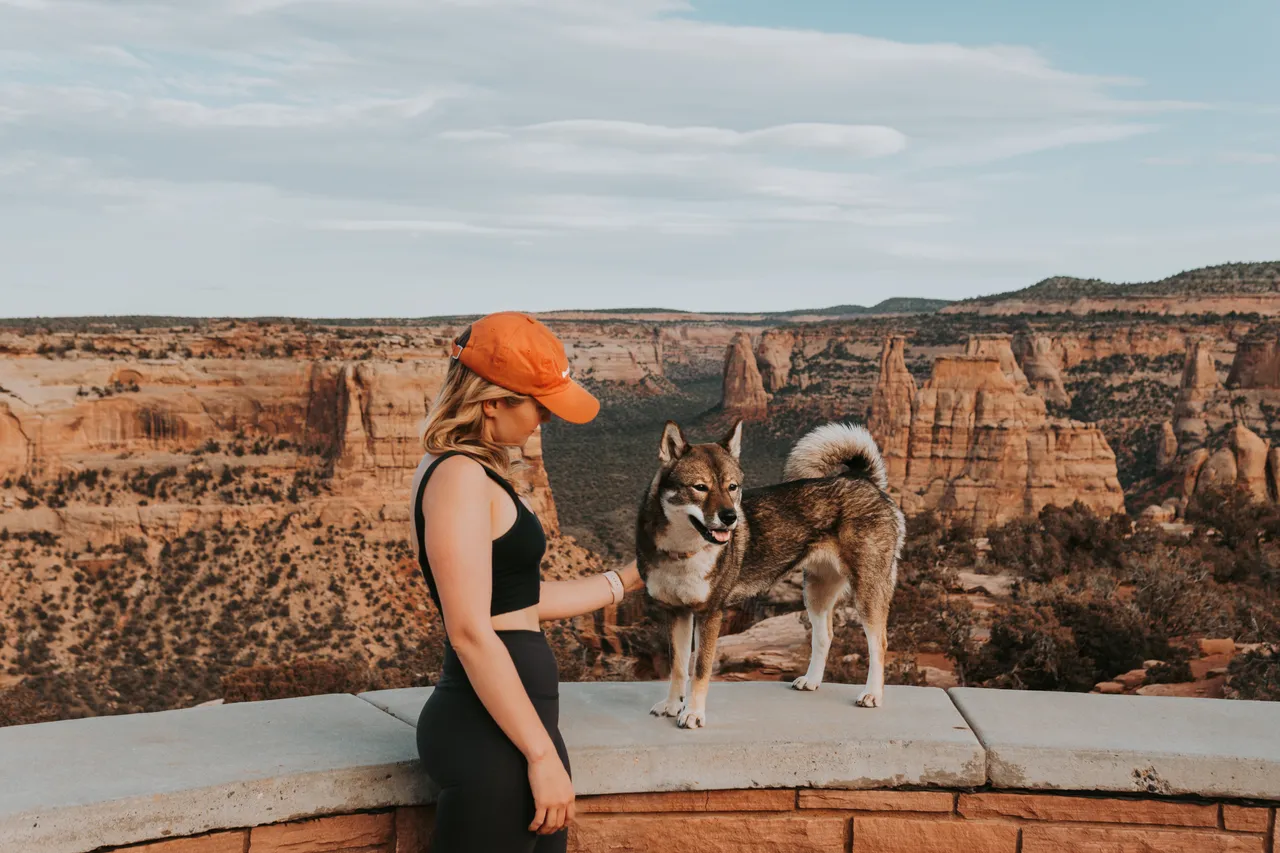
The Shikoku is a Japanese breed originally used to hunt boar and deer in the steep, rugged mountains of Kochi Prefecture. They're compact and muscular — around 35-50 pounds — with a dense double coat and a wolf-like appearance that turns heads everywhere we go. They don't have the relentless endurance of a Husky or the drive-to-work intensity of a Malinois or German Shepherd. What they have instead is something harder to describe: they're fully in their bodies, completely in the moment, primitive in the best sense of the word. Every sense is dialed to 11. They see, hear, smell, and feel everything around them in a way that most domesticated breeds have long since lost.
That sensitivity is a double-edged sword. It makes Sora an incredible trail partner — alert, aware, reading terrain and wildlife before I even notice it. But it also means she feels everything more intensely, which is where the reactivity comes in. She's not just reacting to other dogs or wildlife. She's absorbing the entire environment, all the time.
And here's something I never expected when I got a Shikoku: your dog will mirror you. Many breeds have genetic personality traits that stay fairly consistent, but they can absolutely be swayed by your own sense of self. Dogs learn our behaviors, our reactions, our nervous system patterns. They read our body language, our hormones, our stress — and they absorb it.
I didn't think about this when I first brought Sora home. But after six years, I've seen it clearly. Sora reacts differently depending on who's handling her. When my partner or a friend walks her, she's noticeably calmer. When I walk a completely non-reactive dog that my partner normally handles, over time that dog starts showing reactive tendencies with me. It's not projection — they are genuinely reading and absorbing my emotions, my tension, my energy. If you're considering a challenging breed like a Shikoku, getting yourself to a grounded and secure place first might be the most important preparation you can do. I wish someone had told me that.
After six-plus years of trails across Colorado, Washington, Oregon, and beyond, here's what it's actually like to hike with this breed. The incredible parts, the hard parts, and everything I wish I'd known before lacing up my boots with a Shikoku at the other end of the leash.
This post contains affiliate links. I may earn a commission if you make a purchase through these links at no extra cost to you.

Built for the Mountains (Literally)
The Shikoku Ken originated on the island of Shikoku in Japan, where they hunted wild boar and deer through some of the steepest, most densely forested mountain terrain in the country. These weren't dogs lounging in villages — they were scrambling up near-vertical ridges, navigating loose rock, and covering serious mileage through rugged backcountry. The Japanese government designated them a national monument in 1937, and to this day, there are Shikoku actively used for hunting in Japan.
That breeding shows up on every single hike. Sora is the most sure-footed dog I've ever seen on a trail. Rocky scrambles, loose scree, steep switchbacks — she navigates all of it like it's nothing. I've watched her pick her way across boulder fields that had me using my hands, and she'll do it without breaking stride. On technical terrain, she's in her element in a way that almost feels unfair.
Some of the moments where her mountain-dog genetics were most obvious: scrambling up to Blue Lakes in the San Juans, navigating the rocky sections on the Enchantments trail in Washington, and powering up steep switchbacks on 14ers without slowing down. While other dogs on the trail are panting and looking at their owners like "are we done yet?", Sora's already 10 feet ahead scanning the next section of trail.


The Endurance Factor
One of the biggest advantages of hiking with a Shikoku is their size and stamina. At around 40-45 pounds, Sora is big enough to handle serious mileage and rugged terrain, but small enough that she's manageable on narrow singletrack and I can physically assist her if needed (though she rarely needs it). That medium build is genuinely the sweet spot for a trail dog.
On a big day, Sora can comfortably do 10-12 miles with significant elevation gain and still have energy at the end. I've pushed longer days and she's handled them fine, but I try to be mindful of her limits, especially in warmer weather. After a big effort, she does need real recovery time — she'll sleep most of the following day before she's fully back to herself. I plan for that now and always give her a rest day after a strenuous hike.
The double coat is a double-edged sword. In Colorado winters and shoulder seasons, she's completely unfazed by cold temps, wind, and even light snow. She genuinely loves cold weather hiking, and I've never once worried about her being too cold on a winter trail. But summer is a different story. That thick double coat means she overheats faster than a short-coated breed, so I plan summer hikes for early mornings, bring extra water, and watch her closely for signs of heat stress. If you're hiking in consistently hot climates, that's something to seriously consider.
Compared to the more popular "hiking breeds" — Labs, Aussies, Huskies — the biggest difference is independence. A Lab will stay at your heels and look to you for direction. Sora is aware of where I am, but she's reading the trail herself, making her own decisions about where to step and what to investigate. It's a fundamentally different energy than hiking with a people-pleasing breed.

The Water Thing
If you hike with a Shikoku near any kind of natural water, you'll figure this out fast: they are obsessed with flowing water. Every creek crossing, every river, every stream we pass — Sora locks onto it and pulls toward it like a magnet. It doesn't matter if she just drank from her bowl five minutes ago. If there's a creek, she wants in.
She doesn't really swim — she'll wade in up to her chest and just... stand there, drinking, taking it in, feeling the current. It's one of the most primitive things about her. You can practically see her brain light up when she hears running water on the trail. She will always, always choose a flowing creek over the water I bring in a bottle. I think it connects to that deep primitive wiring — wild canids seek out fresh running water, and that instinct is still fully intact in Shikoku.
It's adorable, but it comes with a real health consideration. If you live in the Pacific Northwest or anywhere with lakes and rivers your dog will be drinking from, talk to your vet about the leptospirosis vaccine. Lepto is a bacterial infection found in standing and slow-moving water, and it can be serious. It's not a core vaccine, so you have to specifically ask for it. Since Sora is going to drink from every creek she encounters regardless of my feelings about it, the vaccine gives me peace of mind on every hike.

The Prey Drive Problem
The Shikoku's prey drive is intense. And I don't mean "oh she gets a little excited when she sees a squirrel" intense. I mean "every muscle in her body locks, her ears go forward, and the entire world ceases to exist except for that animal" intense.
Unlike many breeds where hunting instincts have softened over centuries of companion breeding, Shikoku were still actively hunting into modern times. That prey drive never got bred out — it's very much alive and operational.
On the trail, this means: squirrels, marmots, chipmunks, deer, elk — any wildlife triggers a response. When Sora locks onto something, it takes real effort to redirect her attention. High-value treats help (I always carry freeze dried liver treats specifically for these moments), but there's no guarantee they'll override a close encounter with a marmot.
This means Sora is always on leash. Always. No exceptions, no matter how empty the trail looks, no matter how good her recall seems in the backyard. A Shikoku off-leash in the wilderness is a Shikoku you might not see again for hours. I also keep an Apple AirTag in an AirTag collar holder on her at all times — because no matter how careful you are, accidents happen, leashes can slip, and with a breed that will bolt after prey without a second thought, having a way to track them is non-negotiable. I use a Signature K9 biothane long line on wider trails to give her some freedom to explore, and a standard 6-foot leash on narrow or technical sections. The biothane is waterproof, doesn't tangle, and is easy to grip even when wet — it's been the single best piece of gear for hiking with her.



Learning to read her body language has been key. I can usually tell about 2-3 seconds before she locks on — her posture shifts, her ears rotate forward, and her pace changes. That tiny window is when I can redirect with a treat or a direction change. Once she's fully locked on, it's much harder.
One tip that's worked well for us: if your Shikoku has a good dog friend with solid recall, you can tether them together on the trail. Essentially tie your Shikoku's leash to the other dog so they're connected. If the other dog has reliable recall and a calmer disposition, they act as an anchor. It's not a substitute for your own leash management, but it adds a layer of safety and can help your Shikoku settle into a steadier pace instead of constantly pulling toward every stimulus.

Reactivity on the Trail
I've written a full post on living with a reactive dog, so I won't rehash everything here. But reactivity is a real factor in how I plan hikes, and if you're considering a Shikoku as a hiking partner, you need to understand this.
Shikoku can be aloof with strangers and reactive toward other dogs, especially on-leash. Sora's reactivity is something I've managed for years, and while we've made incredible progress, it still shapes every hike I plan. The biggest challenge? Other people's off-leash dogs running up to us on the trail. It doesn't matter how "friendly" their dog is — an unknown dog charging at a reactive Shikoku is a recipe for a bad situation.
Here's how I manage it:
Trail Selection
I specifically choose less-trafficked trails and avoid the popular spots on weekends. I check AllTrails reviews for mentions of off-leash dogs before committing to a trail. Some of the best hikes I've done with Sora have been on trails I never would have found if I wasn't actively avoiding crowds.
Timing
Early mornings, weekdays whenever possible. The difference between hitting a trail at 6 AM versus 9 AM is massive in terms of dog encounters. Dawn patrol isn't just for the views — it's for my sanity.
Gear
I carry a Baskerville Ultra muzzle for crowded trailheads and sections where I know we'll encounter other dogs. Muzzle training was one of the best investments I've made — Sora is completely comfortable in hers, and it gives me peace of mind. I also use a bright-colored Ruffwear Front Range harness that's visible from a distance, which helps signal to other hikers that we need space.
The Reality
There have been hikes that went sideways because of off-leash dogs. There have been mornings where I've turned around at the trailhead because it was too crowded. There have been moments on the trail where I've had to body-block another dog while managing Sora's reaction. It's not always pretty, and it takes a toll.
But here's what I've learned: the hikes we do get — the quiet early mornings, the empty trails, the alpine lakes with nobody around — they're worth all of it. And reactive dog ownership has made me a more intentional, more present hiker. I notice things I never would have noticed if I was just charging up a popular trail with headphones in.


What Makes Them Different from a "Normal" Hiking Dog
If you've only ever hiked with retrievers, herding dogs, or other people-oriented breeds, hiking with a Shikoku is going to feel completely different. The best way I can describe it: a Lab hikes for you. A Shikoku hikes with you.
Sora isn't looking to me for validation or direction on the trail. She's an independent thinker who's processing the environment on her own terms. She decides where to step, what to smell, when to speed up or slow down. My job is to manage the leash, read her body language, and keep us both safe. It's a partnership, not a handler-dog dynamic.
That independence can be really good on the trail. She's confident on terrain that makes other dogs hesitate. She doesn't panic at loud noises, river crossings, or unfamiliar environments. She assesses situations calmly and makes decisions — sometimes better decisions than mine.
But that independence also means she's not going to sit and wait patiently while you take a 20-minute photo break at the summit. She's not going to cheerfully greet every person and dog she passes. And she's absolutely not going to come running back to you if she slips the leash and spots a deer. You have to be comfortable with a dog who has her own agenda.
The bond that builds through trail time is different too. It's not the eager-to-please love of a golden retriever. It's quieter and deeper. After six years of navigating trails together, managing her reactivity, reading her signals — we have a level of nonverbal communication that I genuinely can't imagine having with a different breed. She trusts me to keep her safe, and I trust her instincts on the trail. That partnership is earned, not given.
A Lab hikes for you. A Shikoku hikes with you.

Sora's Trail Resume
After six years of hiking together, Sora's trail resume is more impressive than mine. Here are some highlights:
- Blue Lakes Trail, Colorado — One of my all-time favorites. Rocky, steep, and the kind of alpine scenery that makes you forget how hard the climb was. Sora absolutely crushed the scramble sections.
- The Enchantments, Washington — A brutal but stunning trail. Sora handled the rocky terrain and long mileage like she was born for it (because, genetically, she kind of was).
- Maroon Bells, Colorado — Iconic for a reason. We go early to avoid the crowds, and the early morning light on those peaks with Sora in the foreground is peak photographer happiness.
- Olympic Peninsula, Washington — Temperate rainforest hiking is a completely different vibe. Sora loved the cooler temps and the million new smells.
- Rocky Mountain National Park — Multiple trails across seasons. Winter hikes here with Sora are some of my favorite memories.
What Sora Loves on the Trail
After hundreds of hikes together, I've learned exactly what makes Sora light up — and what to watch out for.
Snow. Snow is hands-down her favorite thing on this planet. If there's snow on the trail, she will do zoomies probably 20 times throughout the hike. Something about the stimulation just sends her — she goes absolutely wild. She'll catch snowflakes in her mouth, dig her face into it, eat it, roll in it. The energy shift when she sees snow is instant and electric. Winter hikes are her peak happiness.
Flowing water. I mentioned this earlier, but any creek, river, or stream is an immediate magnet. She lights up when she hears it before we even see it. She'll wade in, drink from it, and just stand there soaking it in.
Fallen trees and big rocks. If there's a log or fallen tree across the trail, she has to jump on it. She can't resist. Dense forests with lots of blowdown are like a playground for her — hopping from log to log. Same with boulders. If there's a giant rock, she'll try to scale it. They're little Japanese mountain dogs after all.
Sand. Another texture that triggers zoomies. Beaches, sandy riverbanks, sandy trails — she goes wild on soft ground the same way she does with snow. Something about those softer, exciting textures just gets her going.
The chase. Chipmunks, squirrels, anything small and fast — she lives for the pursuit. But this comes with a serious warning: be extremely careful at rocky overlooks. Their prey drive is so high that they could chase a chipmunk right off a cliff without thinking twice. I take extra precautions at any overlook because chipmunks are always scattered around looking for scraps, and the drop-offs can be genuinely dangerous. This is especially true at crowded hikes like Rattlesnake Ledge — I often don't bring Sora on that one because the combination of chipmunks, crowds, and exposed ledges is too much to manage safely.
Holes. Sora sticks her nose into every hole she finds, searching for creatures. Shikoku love to dig, so watch them if there's mud or soft ground around other hikers — they will absolutely start excavating if you're not paying attention.
Trail Preferences
One thing I've noticed over the years: Sora does not enjoy turning around. Most of the hikes we do are out-and-backs, but her favorites are always loops. There's something about the novelty of new terrain the entire way versus retracing her steps. She's noticeably more engaged on a loop trail.
She's also extremely fast hiking uphill — she could pull me up a mountain if I let her — but very slow going down. Whether that's caution or preference, I'm not sure, but the difference is dramatic.
And an interesting pack dynamic: if we're hiking with other dogs, Sora prefers to be behind them all, following at her own pace. But with people, she'll walk right beside you or lead the way. She's a follower with dogs but a leader with humans.
After the Hike
After a big day, Sora has a routine: drink water, eat dinner, do one dramatic full-body shake, and immediately pass out — usually curled into a tight ball on her HEST dog bed. She sleeps deep and heavy after a trail day.
Recovery is real with this breed, though. After a longer or more strenuous hike, she'll sleep most of the next day to fully bounce back. She's not the kind of dog that's ready to go again the next morning after a big effort — she needs that full rest day. I plan around it now. If we're doing a big hike on Saturday, I know Sunday is a couch day. By Monday she's back to her usual self, pacing by the door and ready for the next one.


Our Hiking Gear List
After years of trial and error (and a lot of returned products), here's what actually makes it into my pack for a hike with Sora:
The Essentials
- Ruffwear Front Range Harness — This is Sora's everyday hiking harness. It has a front clip option which gives me more control, and the bright color helps other hikers spot us from a distance.
- Signature K9 Biothane Long Line (33ft) — My most-used piece of gear. Waterproof, lightweight, doesn't tangle in brush. I use this on wider trails so Sora can explore without being right at my side. For narrow or technical sections, I gather it up and keep her close.
- Baskerville Ultra Muzzle — For crowded trailheads or sections where I know we'll encounter dogs. She can pant, drink, and take treats through it. Muzzle training was a game-changer for us.
- Apple AirTag + Collar Holder — On her collar at all times. With a breed that will bolt after prey without hesitation, a tracker is non-negotiable.
Food & Water
- Wilderdog Backpacking Bowl — Weighs almost nothing, rolls up tiny, clips to my pack with a carabiner. Holds 64oz which is plenty for water breaks.
- Nutri Bites Freeze Dried Liver Treats — High value, single ingredient, easy to break into small pieces. These are my secret weapon for redirecting prey drive on trail. They're the only treat that consistently beats a squirrel.
- Extra water — I carry at least an extra liter beyond what I'd bring for myself
Protection & Safety
- Musher's Secret Paw Wax — I apply this before hikes on rough terrain or in extreme temps (hot pavement, snow, ice). It creates an invisible barrier that protects her pads without the hassle of booties.
- Ruffwear Approach Pack — For longer hikes, Sora carries her own water and treats. She handles the weight easily and it actually seems to focus her energy on the trail.
- Dog-specific first aid supplies (tweezers for foxtails, styptic powder, vet wrap)
- Fido Pro Airlift Emergency Sling — I carry this on longer or more remote hikes. If Sora ever got injured on trail and couldn't walk out, this lets me carry her. Peace of mind weighing almost nothing.

Dog Hiking Gear
Ruffwear Approach Dog Pack
REI
$99.99
Ruffwear Palisades Pack
REI
$149.95
Ruffwear Pack Out Bag
REI
$39.95
HEST Dog Bed
Backcountry
$199
Impact Dog Crate
Amazon
Check Price
Fido Pro Airlift Emergency Dog Rescue Sling
Backcountry
$95
Mighty Paw Dog Tie Out Cable 30ft
Walmart
$18.99
Ruffwear Front Range Dog Harness
Chewy
$48
Signature K9 Biothane Long Line 33ft
Amazon
Check Price
Baskerville Ultra Adjustable Basket Muzzle
Chewy
Check Price
Musher's Secret Paw Wax
Amazon
$13
Nutri Bites Freeze Dried Liver Training Treats
Amazon
Check Price
Wilderdog Backpacking Bowl
Amazon
$18
Apple AirTag
Amazon
$27
AirTag Dog Collar Holder
Amazon
Check Price
Letting Go of Control
A lot of owning a Shikoku comes down to releasing control. You have to let go of the idea that your dog will behave the way you want, when you want, and accept them exactly as they are. You learn to stay aware of their behaviors and adjust as needed, rather than trying to force them into a mold they were never designed to fit.
I love the primitive, wild, curious, intelligent parts of Sora. As frustrating as the dog reactivity can be, she is deeply in tune with her emotions, her surroundings, the earth. She has brought me closer to nature in ways I never expected. She's grounded me. She's taught me to appreciate the small, momentary experiences that I used to walk right past.
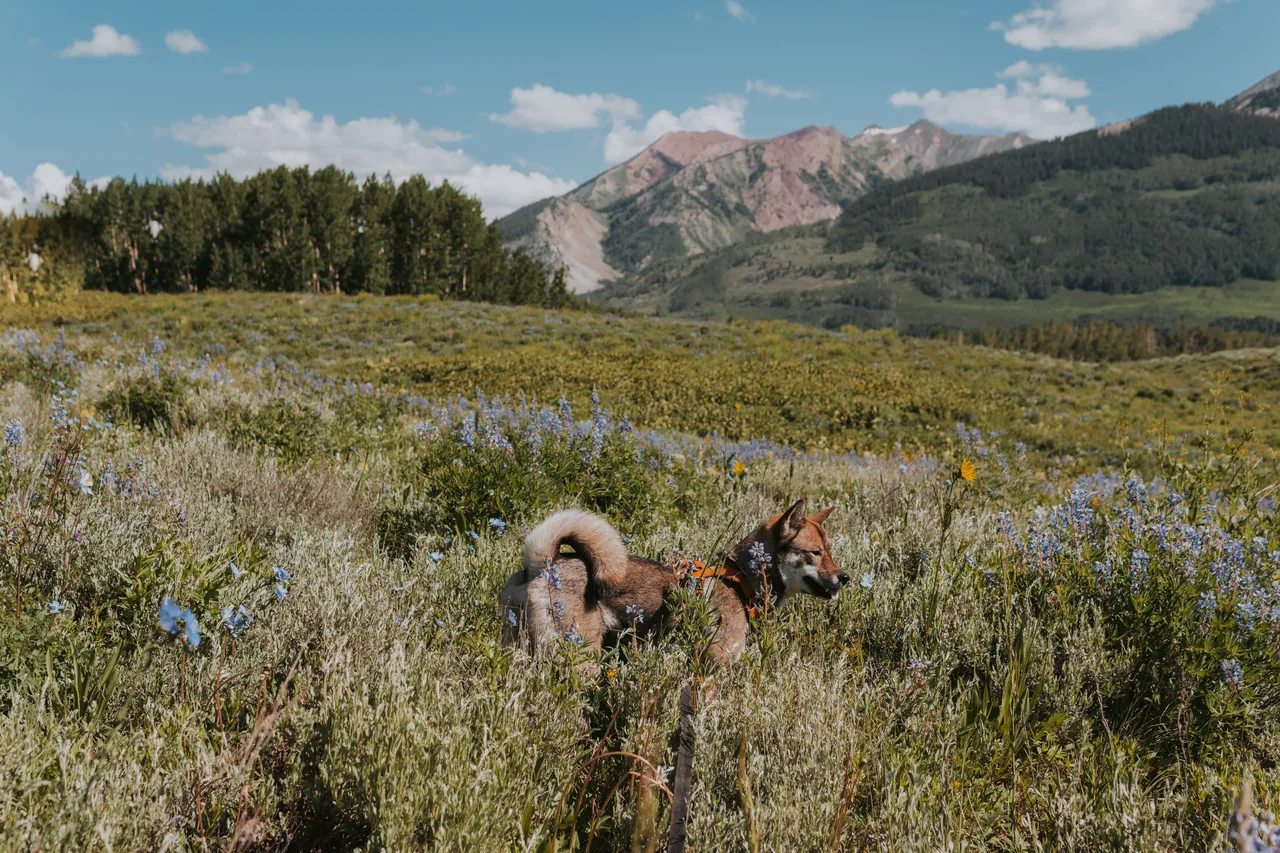
Sora stops and smells every blade of grass. She studies the petals of every wildflower blooming along the trail. She watches bees bounce from one flower to the next, completely captivated. She is excited to take in new information, even when it overstimulates her. That curiosity, that presence — it's contagious.
When we're in the mountains together and we reach a beautiful stopping point, I take off my shoes. We get our feet wet in a creek, then walk through the grass. We breathe in the high alpine air — crisp, refreshing, free of pollutants — and let the golden sun remind us to slow down and take it all in. Our best times in the mountains are when we're the only ones around. When we find a quiet place to sit and peacefully enjoy our own company, together.
Shikoku are true companions in every sense. They aren't easily controlled — they're autonomous, free, wild. And if you can meet them where they are instead of where you want them to be, they'll show you a way of experiencing the outdoors that no other breed can.

So... Is a Shikoku the Ultimate Hiking Dog?
For the right person? Absolutely. I can't imagine a better trail partner than Sora. Her mountain instincts, her endurance, her sure-footedness on technical terrain — it all traces directly back to centuries of breeding in Japanese mountain wilderness. When I'm on a rocky alpine trail above treeline with her, everything clicks. This is exactly what she was built for, and she knows it.
But for most people, a Shikoku is probably not the right hiking dog. The prey drive is relentless. The reactivity requires constant management. You will never let this dog off leash in the wilderness. You will plan hikes around crowd levels and adjust your schedule around other dogs. You will carry extra gear and treats and a muzzle and always, always have a plan.
A Shikoku might be your ideal hiking dog if:
- You're an experienced dog owner who understands primitive breeds
- You prefer quieter, less-trafficked trails
- You want an independent partner, not a follower
- You're willing to put in serious training and management work
- You find joy in the challenge, not just the summit
A Shikoku is probably not your ideal hiking dog if:
- You dream of off-leash trail adventures
- You hike popular, crowded trails on weekends
- This would be your first dog
- You want a dog that greets everyone on the trail with a wagging tail
What I know for sure is this: Sora has made me a better, more intentional hiker. She's taken me to trails I never would have found, pushed me to start earlier, go further, and pay more attention to the world around me. The best hikes of my life have been with a Shikoku at the other end of the leash, and I wouldn't trade that for anything.

Have questions about Shikoku or hiking with a reactive dog? Drop a comment or send me a message on Instagram — I love talking about this stuff and I'm always happy to help!
More on Sora & Dog Adventures
Get new posts in your inbox
No spam — just new adventures when they're posted.
Comments
Leave a comment
Dog-Friendly Travel Guide
This section brings together the posts that have helped me most, from long drives and trail prep to paddling, training, and destination ideas.